Un dialogo con Mehdi Dahkan per approfondire il suo percorso di ricerca, la pratica dell’Aïta e le forme di resistenza presenti nei suoi lavori
Mehdi Dahkan (1998, Tangeri) è un artista, danzatore e regista marocchino autodidatta che fa della danza e del suo corpo un archivio di pratiche che esplorano resistenza, identità e appartenenza. Il suo lavoro fonde estetiche urbane e contemporanee per esplorare il corpo come spazio politico e mezzo di negoziazione, il cui fine ultimo è mettere in discussione ideologie e costrutti sociali connessi al Maghreb contemporaneo. Il percorso di Mehdi nella danza è iniziato in giovane età con la breakdance, il parkour ed altre discipline urbane. Ha successivamente esplorato la danza Bollywood e infine quella contemporanea. Nel 2019, Mehdi ha fondato Jil Z, dando inizio alla sua ricerca coreografica. La sua pratica trae ispirazione dall’interazione delle diverse estetiche del suo background multidisciplinare. Da allora, ha creato diverse opere, tra cui MA’KAN (2019), BNI MAKADA (2021), ONLY 14 (2023) e SUBJECT TO (2024). Le creazioni di Mehdi sono state presentate in prestigiose sedi e festival, come Charleroi Danse (Belgio), Belfast Arts Festival (Irlanda), Museum of Monologues (Istanbul), MMAG Foundation (Giordania), Frankfurt Lab (Germania), FIAC Festival (Brasile) e SummerWorks Performance Festival (Toronto), tra gli altri.
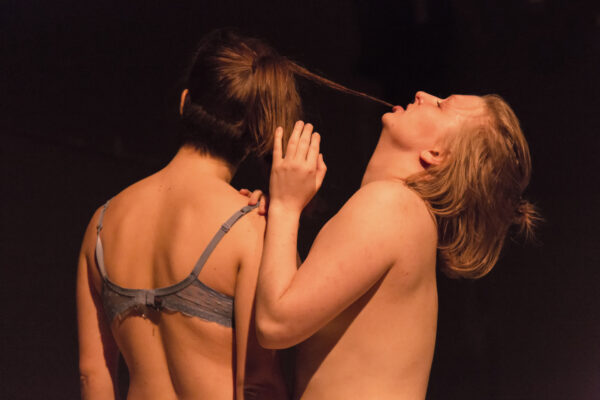
Con il laboratorio RE.M Redazioni Multi.lingue di Up To You/progetto Come Together abbiamo avuto la possibilità di incontrare l’artista ed intervistarlo in vista dello spettacolo KMs of RESISTANCE, che ha concluso la settima edizione del Festival Up To You 2026. Una performance coreografica e sonora che esplora l’atto primordiale del respiro come mezzo per esprimere resistenza e ispirare l’azione collettiva. Trae ispirazione dall’Aïta, una tradizione orale marocchina storicamente utilizzata per trasmettere messaggi e incitare alla resistenza durante il Protettorato francese in Marocco. Reinterpretata in un contesto contemporaneo, l’opera offre un modo sottile per affrontare le urgenti problematiche odierne, in particolare in contesti in cui la libertà di parola viene soffocata o censurata. Ponendo il respiro al centro come materiale sonoro essenziale della resistenza, l’opera crea una forma di protesta senza slogan. Il respiro diventa quindi un promemoria simbolico di ciò che ci unisce al livello più fondamentale: il nostro bisogno d’aria, la nostra fragilità, la nostra interdipendenza e l’urgenza che si prova quando la nostra sopravvivenza è in pericolo.
Cristiana Burini, Matteo Piantoni

What is your path in terms of artistic formation? When did you start to be interested in your work and what is the path you undertook?
«In the all arab world it’s mostly the same, if you are a man you start your dancing career with breakdance and hiphop, because those are the most accessible and more physical ones. I started breakdancing mainly to do the hardest moves. During events in Morocco I started to meet people from different dancing backgrounds that did contemporary dance, like from Spain etc. Slowly I started to understand that a bigger world exists, and I started to feel the limitation of hierarchies in breakdance: the fact that there’s one winner, the “I’m better than you”… and I like the contemporary dance and creation in general, because it’s an open stage where you can talk about anything and can decide to dance or not to dance. One thing I’m really really interested in is how to speak with the body and how the body can become powerful to resist, to protest and to manifest without saying a word, because saying words can get you problems. I’m interested in all these practices in which art has been used to resist, to express something without using the words. It’s always bodies in movement, but a specific type of movement».

Can you tell us something about the cultural life in Tangeri and political and social reality in Morocco?
«The street has an important role in this society. Everything happens in the streets. I did all my dances in the streets and it is a way to make yourself known through competitions and going to events like dance battles; those are the encounter places everybody wants to go and participate.
We keep complaining that in Morocco, for example, people won’t go to theatres. But the ideas of the theatre in people’s minds it’s a remain of colonial history. Moroccan theatre is something that existed for a thousand years. When you go to Marrakesh, you go to this big plaza that’s full of performances: there’re people charming snakes, people with whatever.. and you have a circus of people all around… that’s more of a theatre, that’s where people go to express themselves. It’s very political. In that place men can dance and wear woman dresses, it’s like all the freedom of the theatre has existed in these kinds of spaces, we can’t force the people to go somewhere they won’t go. There is freedom of speech but in Morocco you have to be careful of what you say and make it funny and metaphorical to avoid possible complaints».
Since we’re talking about the artistic background we would like to know about the Aïta, this moroccan folk music style. You use some of its characteristics in your own performances. Could you elaborate more on that?
«Aïta is a form of art that was created in the French and Spanish colonies. There were two theories: first of all Morocco is a very big country; there were all these tribes in which there was no connection between them, there was no journal or radio, there was nothing. And so it [the Aïta] became the communication tool in war between tribes.
Second of all there was the idea that since the tribes were so different, instead of going into the process of deciding which language they should have used, they’ve looked for a thing everybody had in common: the crying/shouting, a universal sound and a universal voice. If you cry or shout: that’s very powerful. Later on the words came, and each area started studying languages. When Morocco gained independence Aïta became less politicised and shifted into a folklorist music style insult-sounding proved of a moral significance.
In my performance I get inspired by the story of Aïta, not really by the practice itself. The music and rhythm performed is a harmless resistance through the body preserving the political idea to use the shout, and breath, to convey a message of resistance and to create protest.
There is a link between the features of Aïta and how it is connected to a wider political resistance: during a conventional protest you can see there’s a complaint and what it’s resisting to. It could be a fight you don’t relate to. You only see the intention, you only see the shout. Meanwhile in my performances everybody sees whatever they’re resisting to. Everybody has different struggles and I like the idea of keeping the protest open to everybody to put whatever they’re resisting in it when they watch it. That’s why the use of breath instead of spoken words. And also because, in this way, government people can’t say anything, you can’t tell me not to breathe in a certain way: it’s my breath. It’s very powerful because nothing has been said. Breath is a very political act: it is the only thing I really have, and it’s the only thing we really share. It’s inclusive: if I speak arab, then i’m only talking to arabic people, and it happens in all performances. If there’s a language you don’t know, you don’t feel included. But if there’s no language then… Ah! That’s also for me».

Emma Goldman, the anarchist thinker said “if i can’t dance i don’t want to be part of your revolution”. Do you believe bodies liberation leads to the liberation of thoughts or vice versa? or maybe both?
«I think that where it started is thanks to your body that you exist and through your body you explore the world. At a certain point you understand that you can’t fly and that there are physical limitations. At a certain point I remember things like the censorship of the parents for example “don’t say things like these” or “don’t move like this” “you can’t behave like this” so they start to explain to you that your body is able to do something in the space or by itself and you start to understand the society you are in. I think everybody, everywhere, is free and can do whatever they want, but society forces you to make things with your own body. I think it is this idea of movement and the body is what you use to read the whole world and I think is the first place where resistance can happen. I think the moment I started to dance in society that used to see dancing as a very weird thing, but is a very big resistance already. I know people and women that went into prison for dancing in a public space like in Egypt, they got actually arrested for dancing in public space, for a very simple action. We have to understand that the body is definitely a political tool. It is not by chance when we want to do and change something we used to walk together. Now we sign a petition and we don’t give a f*ck, think of it: three hundred thousands people sign and this is not gonna change anything, but put those people walking down the street things will change. There is something about the body moving and synching together just walking from point A to B and we need to pay attention, because those bodies that can walk together can fight together. It is a demonstration of unity doing the same thing with my body and your body. Same thing when I say a thing alone I am weak, but if I am with another million of people saying the same thing it is very different».

Is the show [KMs of RESISTANCE] with two performers? How does the format change?
«It is with one or two performers. The first time I was working on my own on a work that is about inhale and exhale, there is a lot of duality, so for me, when I was working, I felt very frustrated and I was like “ok I need somebody that work with me and create this duality with me”. I felt like two people represent an intimate story: it is not a group, it is my favourite thing of it, and then the idea of the group came in. I performed with people that thought “ah you had everything in mind and do you imagine it in a group, and I was like – yes” and people who asked were not so sure and the question led me to the energy to see the group the first time we did it. We were in Rabat the first time I performed it and I really liked it, although I propose different formats as I like to play it with numbers of people».

When you started to do this performance, did you plan to create this contamination in which people started to get more and more until becoming collective?
«No, people showed up and then there were more and more. It is all about creating the space of the magical where the collective is able to make it (the performance) and not necessarily to convenience them but to allow it, if you have the good condition it happens, always. With the place you have to be inclusive that’s why there is no language, no music».
Talking about movements we would like to ask you, are there just movements that unconsciously keep recurring in your work? Also, are there impossible movements for you to make, emotionally or politically?
«I think there are movements that keep coming out. It’s the movement that came from when you used to dance as a child and things that are put into you in your childhood. I remember how I see my father and uncle dance and I now I am like “I don’t know where this came from” and it is not necessarily a movement but a way of movement and I think, maybe because we share some values, my father it is very specific: when he is talking he is looking at something he makes some kind of gestures doing this and this, it is a very weird shape. You observe and it goes into your consciousness and you start to find it because you are digging so deep into your consciousness, taking from those moments and images. The more and more I’ve seen it the more I go into depth. I think for sure if I want to make big problems for myself in performing in Morocco. There are certain ways of moving especially with the feminine male body; the masculine female body in Morocco would pass, it is still seen as powerful. But the feminine male body in a society where the man is still very dominant, in the current Arab world I would say it is the hardest one (to accept).
There are just small things like when we are working on breath we share this idea of the “last breath” in which we share this deep breath and we go very close we don’t have any fear and each time we performed in Morocco, first time I heard comment from people, it was in a popular neighbour, I was surprised the majority of people came and loved it, so they were pushing a bit more next time in Casablanca; in Rabatt they performed next to the government people, so they decided to do it far away from eachother, but during the performance I messed it up, I researched the video and I noticed it (laughs). I think it is how it should be for now because you fight a stronger opponent so it is pointless: you are weak, you just gonna get smoked from the beginning. The idea is not to go for the piece only with controversial stuff because it is not gonna be allowed, but to perform a bit of those little by little and slowly keep pushing. There is the contact with the eyes that is disturbing as well as when there are two men touching each other; if there were men and women okay but man and men, ugh. We will just go with that».

Which is the collection of the show, what’s the relationship with EU’s, France’s and Morocco’s artistic production and also the audiences?
«In my case, like many other artists in Morocco, their works go to the EU, you create the work and then you go to perform it. Morocco is just the human resource but financial resources are also from here, which makes sense that people receiving public funding from Europe is your money, if it comes back to you it makes sense».
Is it a colonial circle?
«Maybe, it is a colonial circle but maybe it is globalisation of the access of information, it can be seen as both. But in this case for me it is important because there wouldn’t be a foreign institution interested in what is happening here and this was the talk we had with the ministry of culture. He said that, in our country, folklore dance for every region existed for thousands of years and it is interesting to put dance in festivals, but putting it in a contemporary lens that comes from an European or western world, which is understandable but it is a very old-fashioned perspective for me. There were nice arguments on both sides but I don’t want to be supported by them economically. There are two reasons: the first one is because they gave you money and with this money your work becomes controlled and I want my freedom. Second of all I’ve been lucky to have this openness with the world those Arab funds that are not necessarily Moroccan found. You can make it work very easily if you are familiar with the system, if you have people that can create bridges between cultures and benefit from both so it is helpful if it can continue in a good way. It’s – I wouldn’t say sad – but you have understood there is a difference, you know Morocco is not like Italy or France, even if you go and see Marrakesh or Rabat you say “wow, very impressive!” If you go to France even in a small village and see a theater, it shows how far it is from other countries. Morocco has amazing cities but as soon as you get a bit of a city there are not and people are crazy, there is less services like hospitals. I am not saying culture is more important, the point is to invest in the people and perform in the street. I create two versions of performances: theater and street version so in the street there is an ecosystem of people and people and public space».

As an artistic direction, we had to choose a claim. We felt a necessity to underline the importance of doing something for the community and for our colleagues of the same age. We chose to have the claim “Up To Us” . We would like to ask you what your opinion is on it.
«I saw it yesterday and I always had this idea both in his personal and artistic life. When he saw the place of the festival I felt it was like a sign. When I talked with the guy of the Moroccan government on art, the participants were accusing the state of not doing enough. At some point I did the mature one and I was like: let’s change the conversation. What do I have to do and what should I start before asking you to do something? At some point people are responsible for many things, who put Donald Trump into power? It’s us! The change starts with us, it will always come from us».

Do you want to talk about Subject To, the performance you were supposed to do?
«If I have to be very honest, I feel a little relieved and happy because it is a painful performance. Subject To came from observation and a critical and endless idea of crossing. If you are from Tangeri, it is a city in-between, you have all Africa that comes through that city because it is 40kms to cross (to reach Europe). We have many stories we hear each time of people crossing the border to Spain and some people swim to it. I had this image of the port, now it is not there anymore because they took the port outside of the city, but growing up I remember the port in the middle of the city where masses of people – sub-saharan immigrants moroccan, arabs – as soon as there were a truck they tried climb it to cross. Everyone wants to cross. What happens when you cross? That’s why the idea of the candle, because in Morocco we call “burnt” the people that cross illegally, so the idea of “something is burning” but what? your identity? your paper? So the idea is something that burns, that becomes a part of your top of a layer, it burns your skin and now you have your new skin, now you have your European skin, you have to adapt to».

Do you believe that “burnt people”, people who get to the other part of the sea feel kinda guilty for leaving other people behind?
«It is part of the cultural thing to push, you are the hero of the family if you make it. I remember I was working in Spain and I couldn’t renew my visa and I told my mum and she suggested “why don’t you stay illegally?” and I went like “are you crazy?”. Now it has changed but people used to believe if you go to Europe you save your life, but Morocco had changed a lot. In the last 10 years there is a great development, and this is changing the narratives. In the Arab world, for example in Tunisia, it’s still the same, “Europe is the solution”. You really feel the change also the football team helped, people are so proud of it. I think there are many elements that make people love their country and make it a tourist destination. The only thing that is scary now is education because the only people that have a good one are the ones who went to Europe. Education in Morocco is still very weak. Education refers also to the mentality like in the way you live with other people, it is not necessarily school but also society. It is very scary in some rural areas, because people there are very extremist, conservative and hate modernity».
How can we make a difference?
«It is with education. In Morocco the king Mohammed II was scared of education. He had a close friend that in the end when he was in power, “you are a genius and better of me in everything help me put the country forward” he said “give me the ministry of education” The problem is that it also gives critical thinking and being critical of the king. So the king said “give them enough education to work” he was afraid of people revolting against him. The idea for me has always been education, also I come from Moroccan school. I remember Islamic studies. I remember I was always questioning “ah you’ll go to hell” they replied. This was a sign of critical thinking, you cannot tell me this and I will just follow you if not you are a dictator of though we have dictator of the or though religion or something else, but religion is problematic because I go to some area like you go to Gaza or Palestine, I don’t believe in religion, it is very sad there is no god no hell and Nethanyau will die with no problems, it is hard to accept, it is very sad, so it is better to see religion as a relief».

Since you mentioned Palestine, which is the form of resistance you saw the most and which similarity you’ve noticed the most in people’s experience?
«I think this is as simple as being present in the same space at the same time. I think it is the most strong form of resistance, like walking from point A to point B. Existing in the same space regardless of your orientation is important and it is already powerful. I think it is crazy but a lot of people now come back to the community that we are losing with the individual market. People are extreme when people are isolated with no activity around when you are by yourself looking at a screen because it is easy to be influenced. When you go out and meet other people like in Italy or Morocco you can confront people and balance it out, if you are at home it is easier to listen to hate and extremists».
What’s your freedom to move as an artist?
«For me it was when I struggled with my visa that it was difficult to move out of the country. It was the period when Morocco started to fight with everyone, even with Spain and France especially for the Sahara. At a certain point me and my partner wanted to marry just for papers so she shared the privilege. As soon as you are able to, you go, especially the mobility as an artist is very important.
What other languages do you know?
« I know Darija (different from classical Arabic), classical arabic (Saudi Arabia), french, english, spanish, so it is five languages».

COREOGRAFIA Mehdi Dahkan
CON Mehdi Dahkan
COPRODUZIONI Piattaforma di previsione; Ettijahat – Cultura Indipendente; CCN du Havre Normandia; AFAC – Fondo arabo per le arti e la cultura; Piattaforma IN SITU; CNAREP Lieux Publics; Metropoli Forside.
SUPPORTO ALLA RESIDENZA Institut Français du Maroc, Tangeri; Teatro PimOff Milano; Consiglio svizzero ProHelvetia; Caserma Basilea; Centro coreografico Pole Pike; Centro BASE & Zona K Milano.